

43.6K
Downloads
556
Episodes
A fun take on the latest science news with enough data to sink your teeth into. Lagrange Point goes beyond the glossy summary and gets in depth with the research from across the world.
Episodes
Dec 23, 2019
Dec 23, 2019
15 min
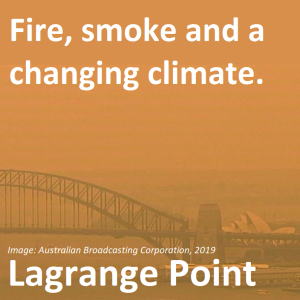
As the climate changes, wildfires become more common and more dangerous. Smoke clouds from wildfires can linger for weeks, but what chemistry changes inside the smog? Aerosols amongst other particles lurk inside wildfire smoke. How do we study the changes in wildfire smoke; by flying planes through the plumes. How do wildfires impact the CO2 emissions of a region? Can wildfires help store carbon through charcoal? What can charred biomass to do help capture carbon?
- Kouji Adachi, Arthur J. Sedlacek, Lawrence Kleinman, Stephen R. Springston, Jian Wang, Duli Chand, John M. Hubbe, John E. Shilling, Timothy B. Onasch, Takeshi Kinase, Kohei Sakata, Yoshio Takahashi, Peter R. Buseck. Spherical tarball particles form through rapid chemical and physical changes of organic matter in biomass-burning smoke. Proceedings of the National Academy of Sciences, 2019; 201900129 DOI: 10.1073/pnas.1900129116
- Matthew W. Jones, Cristina Santín, Guido R. van der Werf, Stefan H. Doerr. Global fire emissions buffered by the production of pyrogenic carbon. Nature Geoscience, 2019; DOI: 10.1038/s41561-019-0403-x
No comments yet. Be the first to say something!